

Alone, Together
Where climate change and disaster meet an animate world

We say it to each other like a shared prayer. We were alone out there. We got out because our senses or our neighbors or our families urged us to, not because of an evacuation order, which for many came far too late. It’s the reason my close friends didn’t leave until they’d woken their neighbors to evacuate together; why my next door neighbor Phil and his brother fought the fire at my house with garden hoses and pressure washers. All of our homes ended up burning. We’ve scattered in all the directions of the wind, but the pact unites us—alone out there, yet together.
I suspect we’ll all be alone out here for a while, if not forever. Since certain men, as Jackson Browne put it, learned to “forge [the earth’s] beauty into power,”1 the rest of us are left to grapple with the consequences (and, maybe, with our complicity). I’ve just been camping in Death Valley, where rainfall over the last year has been sparse, and there are no spring wildflowers to soothe my specific kind of climatic weariness. Soothing it isn’t the point, though; I don’t wish for a different season than the one I’m in. But I’d like some small hope for something better down the road.
The earth is animated by largely indifferent forces, some of them gloriously colored. A green-backed, purple-throated Costa’s hummingbird darts closely between my companion and me as we set up and sit around camp. We are in his territory, and he is letting us know; at close range, over and over. At night, wind shakes the tent like an animal nudging us awake. It’s warm and the sky is dark with the new moon—good for stargazing—so we sleep with the tent fly off, but wake to the unexpected pat-pat-pat of rain falling on us before dawn.
In the morning we head out through a huge wash which we’d been through two years before; back then an endless stand of creosote skeletons. Miles of spindly brown shrubs. This year’s been dry, but last year the rains were historical, and the wash today is green with life and the smell of desert rain—blooming creosote. The shrubs all hang heavy with starry yellow flowers, and a hummingbird zips between them.
“Do you think all the creosote are related?” I wonder aloud, only partly joking. They can reproduce clonally, and the shrubs are spaced suspiciously evenly, like they are one organism with excellent spacial awareness. Maybe they all live and die in unison, like inhaling and exhaling. Speed up deep time and that might be just what it looks like. For now, they drink deeply of the groundwater, sipping from a great lake beneath the terranean networks of sand dunes and ancient rock—some Precambrian, more than a billion years old, among the oldest on earth—cracked here and there with springs. The green of life, a hopeful omen.
Other portents are less promising. Since the fifteenth century, Shinto priests in Japan have kept a record of a great ice ridge which formed on Lake Suwa’s surface nearly every winter. To locals the ridge is known as Miwatari, or “sacred passage,” the path walked by a god across the frozen water. The ridge hasn’t appeared since 2018, the longest absence in its recorded history. When we render this earth unlivable for the gods, the very natural forces which compose it, we are truly alone.
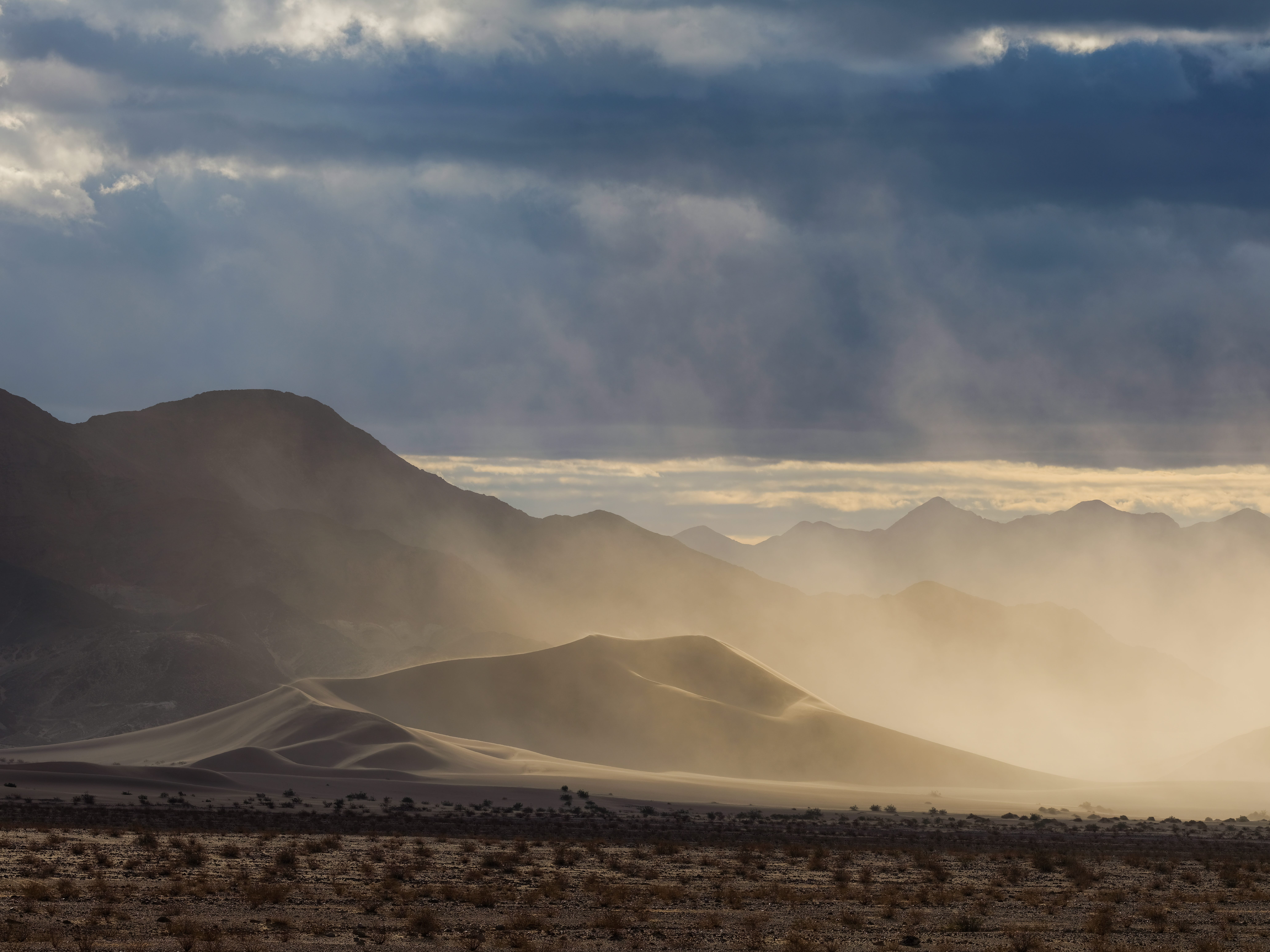
A dust storm dances through the valley, lit by the rising sun like desert fog, and I can just make out the old road, miles away down there, no one on it. There are many ways to be alone. There is the self-abandonment stemming from neglect of the natural world—true isolation—and then there is the solitary work of reckoning with our shared fates. Those of us clinging tightly to the sparks of life, helping to keep them lit, often in the dark, often alone; we must find ways of being—and staying—together.
“Before the Deluge” by Jackson Browne (1974)