

On Belonging
to the Earth.

Thank you for reading Tinctoria, the monthly(ish) newsletter from me, Erin of Berbo Studio. For now, I’m pausing regular transmissions of the Dyer’s Almanac, a seasonal guide focusing on specific dye plants, and moving into sharing more personal and observational writing, still about ecology and natural color, like the essay below.
Paid subscribers to this newsletter are supporting this work—thank you so much—and will continue to receive content made just for them. The essay below is public, so please feel free to share it with anyone who might enjoy it.
Next month, I’ll be announcing my schedule of spring workshops in Southern California! Stay tuned here to learn more about these offerings, and to sign up (they usually fill up quickly).
Keep in touch: Web ꩜ Instagram ꩜ Email
On Belonging
When I got to the gate separating the half mile of dirt road ahead from the twenty miles of dirt road I’d just driven in on, it was locked. I knew it would be. It’s the off-season, just one ranger on duty in the whole valley, and I’d hoped to find him here, but there was a note on the window of the darkened visitor center: Out on patrol.
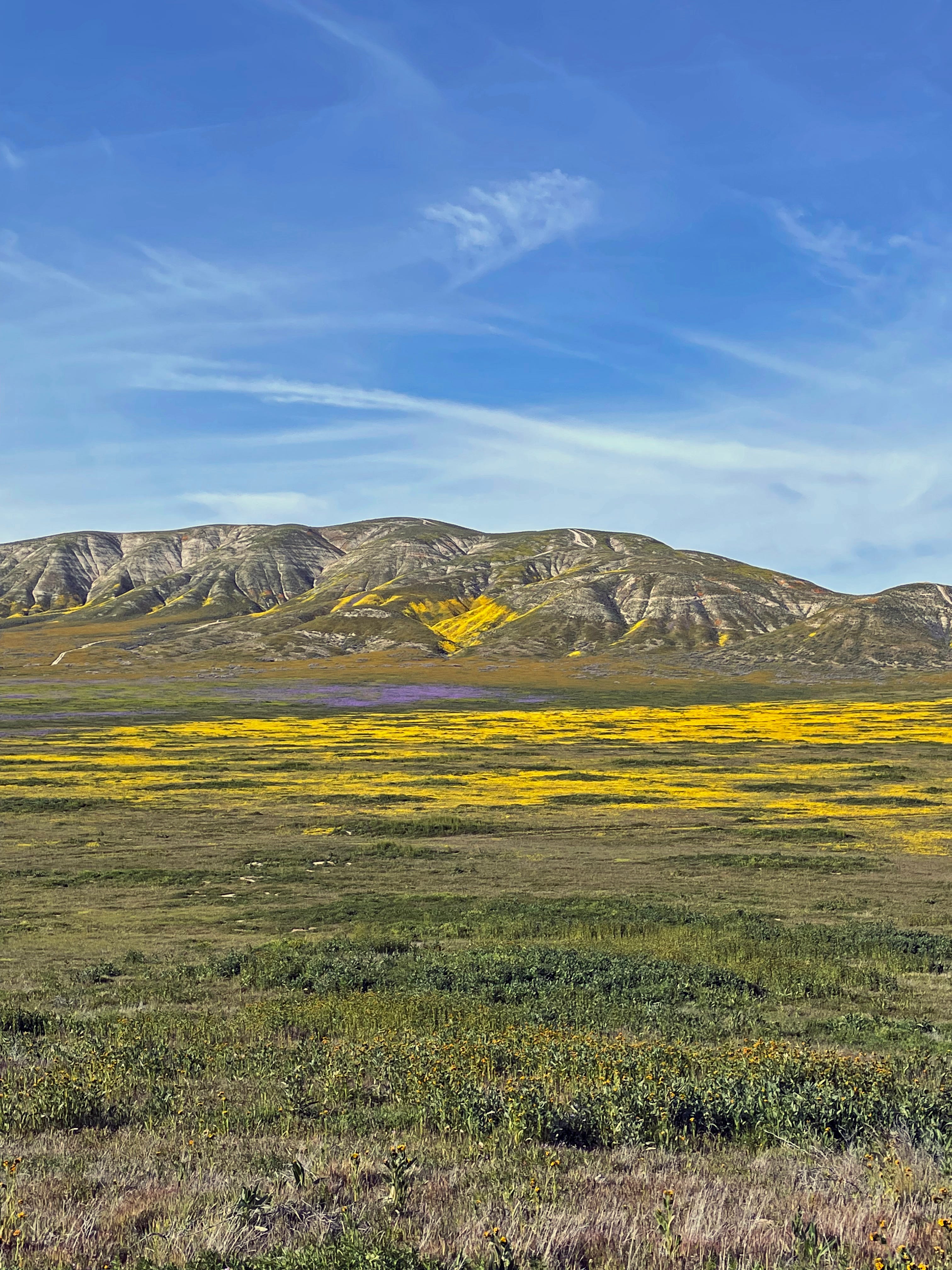
From the parking lot, a tiny dirt square carved out of the valley, now in its endless green post-rain regalia, I could see the great sandstone formation looming in the grassy sea, and the dwarfed metal gate enclosing it. The grass around the rock rippled and shimmered as the wind combed through it, teasing out a thousand different shades of green. The rock stood, unmoved. It had seen countless days as glorious as this one. It would see countless more.
Back on the road, a white pickup was kicking up dust in the distance. In a minute we reached each other, slowed and rolled our windows down, as you do when meeting another soul crossing the same lonely road. It was the ranger. His eyes smiled and seemed surprised to see me. I’d encountered only one other person in the valley that day; a rancher in a truck who’d tipped his hat as we passed each other at a muddy crossing free of fresh tire tracks.
The ranger and I leaned out our windows toward each other. “Is the rock closed for the season?” I asked.
“No—I’m headed that way. Got a pen for the gate code?” He called out the numbers over his shoulder, then rolled up his window to shield from the dust.
I followed in his wake back toward the gate. He stopped near the visitor center to locate a shovel and traction boards from a shed; a vehicle was stuck in the mud on the other side of the valley. Getting back in his truck, the ranger listed off the rules for visiting the site: Stay on the road and trails. Don’t climb on the rock. Personal photos only; no posting on social media. With that, he headed back into the vast flats of the valley, and I continued up the road toward its rim, repeating the gate code in my mind like a mantra.
My heart pounded lightly in my ears as I clicked the hefty padlock open and swung the creaking gate against the wind. I was excited and a little nervous. Did I belong here? I’d just been given official permission to enter the area, so yes, I was allowed to be here. But did I belong here?
I’ve been asking myself a similar question for the last year, since relocating to a small town not far from the vast valley. The town is in its own valley, perched upland from the ocean in a nest of mountains, in its own little world. Still, you can reach a small city nearby in a thirty minute drive, and big cities in each direction in one or two hours. In that time you could also drive to the last town I lived in, which burned in the Eaton Fire last January.
I arrived in this new town like an animal seeking shelter and safety. My home was gone, so I migrated elsewhere looking for a new one.1 The new town—I wouldn’t call it home—is inarguably lovely. Neighborhood blocks fade in and out of orchards and oak groves and horse pasture. People say hello, as we walk by, good morning, and most of them are.
From the front door of my one-room house I can walk to the river, cross it and head into canyons and up mountain ridges, connect with other trails which connect to yet more trails, and access countless miles of essentially walkable wilderness. I’ve spent the last year walking the trails outside of town, learning to belong to a new place, finding its rhythms, and attempting to sync my own with them.
The land outside of town—hilly country cut with gorges, forming swimming holes and hot springs; conifer-covered bluffs over rivers watering meadows which fill with wildflowers in spring; ephemeral salt-rimmed lakes, full of rain, reflecting the sky like diamonds—is home. I don’t feel at home in the town. Do I belong? Does it belong to me—or any of us? Tourists come through every weekend. I go up to the mountains, past the popular hiking trails. Sometimes I keep driving, right into the next valley.
I lock the gate behind me, close my car door to the wind, and head up the short rugged road, which ends at the trailhead, which leads to the rock. The road arcs above the valley but stays snugly below the low bluffs which border it, traversing a delicate edgeland: the line between shelter and exposure.
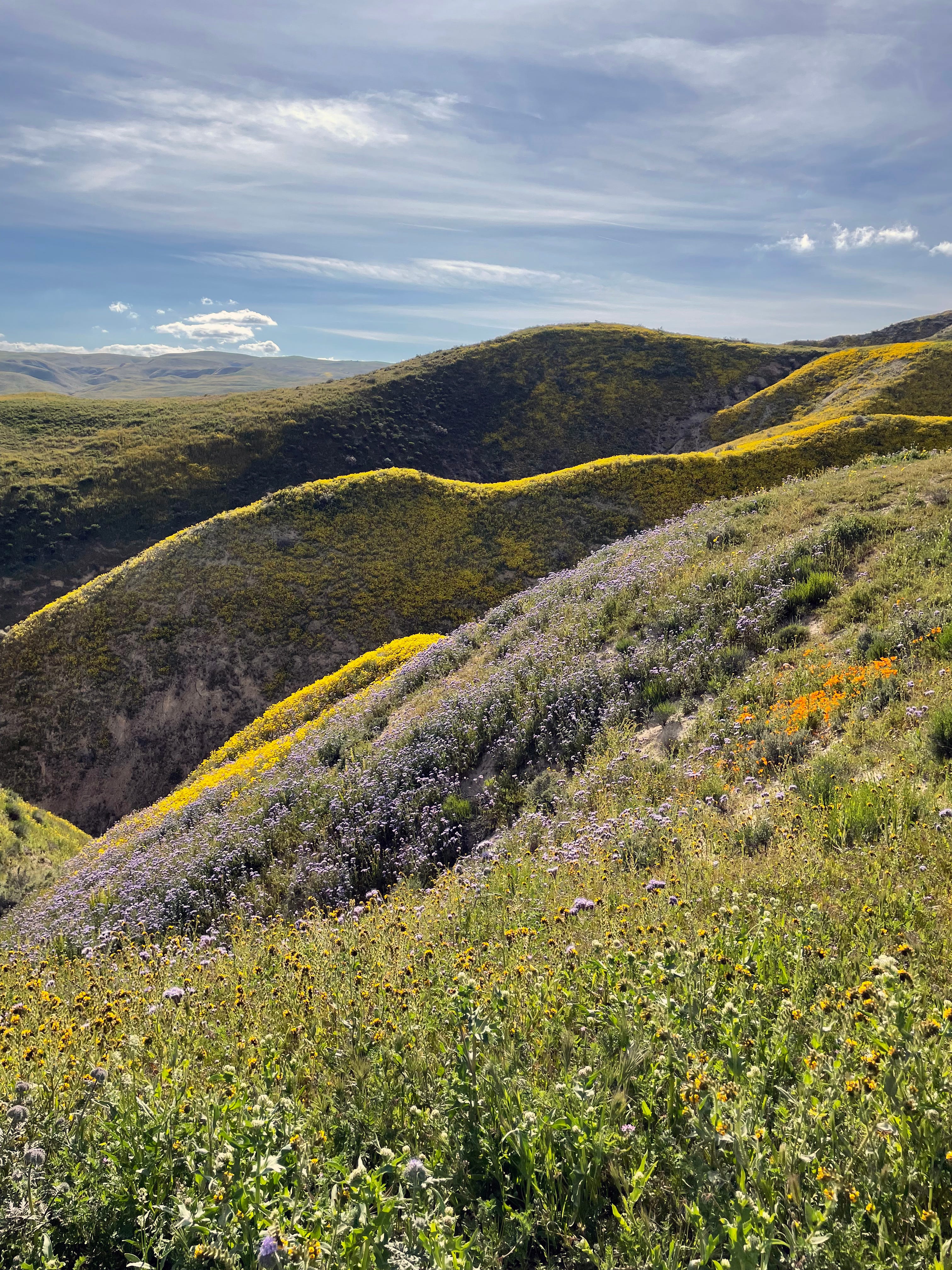
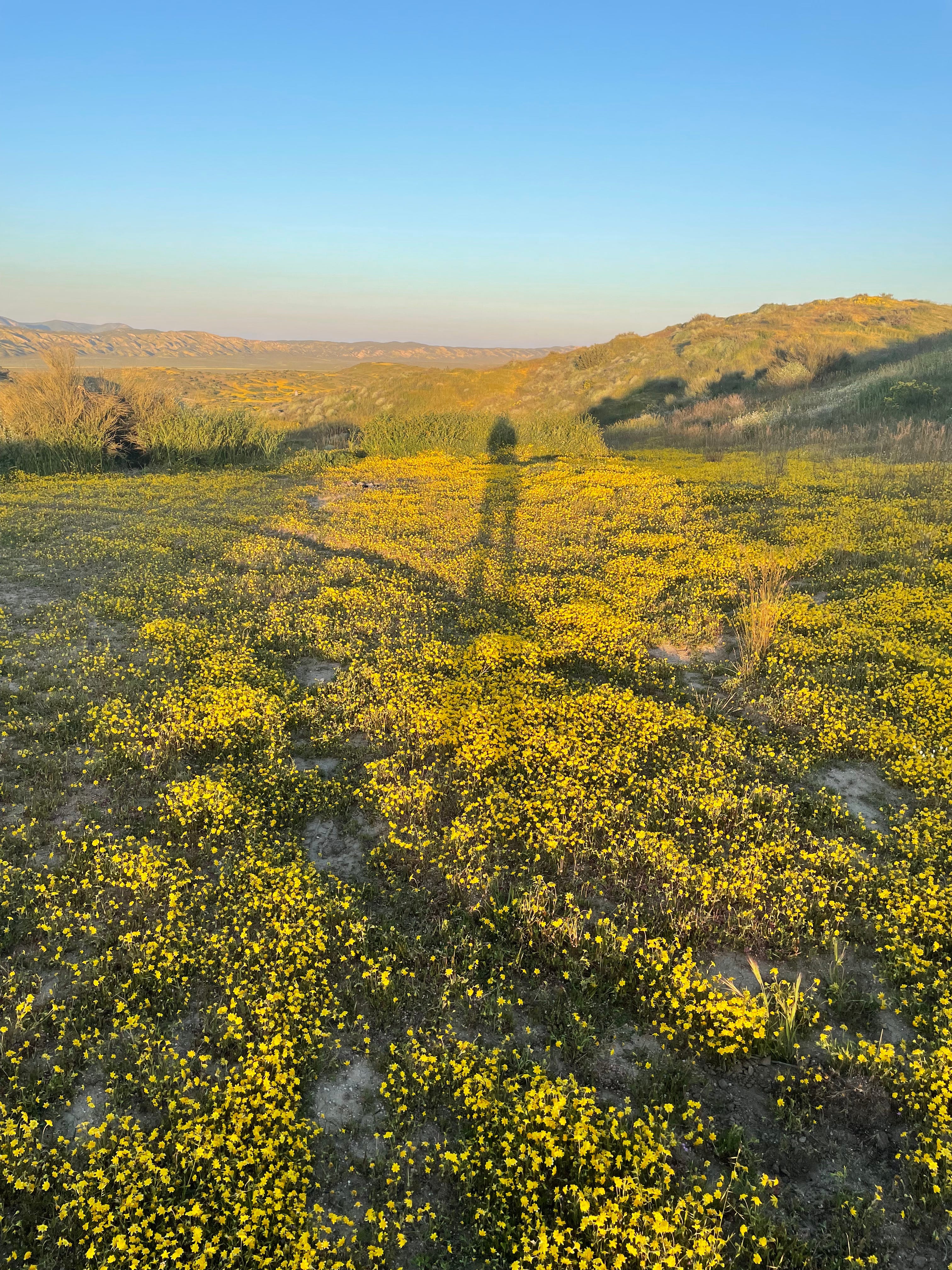
Last time I was here, the valley was in full flower. Upland and lowland were covered in swaths of yellow and purple and cream—goldfields, owl’s clover, creamcups, lupine. We camped in the hills with a view down-canyon, gazing into the bloom, which carried on into the valley and over the next mountain range, glowing pink and orange as the sun set. There is a deep solace, an assuring feeling, in a densely flowering place. Back home, I read about our biological response to flowers, which signal to us: Food. Many flowers mean many seeds, many of them edible and nutritive. Abundant plant life indicates to us: My needs could be met here. We can sense where we belong.
I park and start down the trail. The winter sun is in its afternoon repose, casting a low gold light over the plain below. From here I can see a fine earthen thread running across the flat expanse of the valley, and a single gleaming thing moving along it—the ranger’s truck on the road. The stone comes into view, huge and smooth, a lonely sand-colored shape molded by a bygone river and millions of years of exposure. Its posture near the valley rim gives it the air of a sentry looking down upon a kingdom.
The wind and I are on the same path, both headed toward the rock like we’ve caught the same swell; gravity pulling us in one direction. The wind moves faster, so I pick up my pace. The rock’s weather-smoothed surface soon fills my vision, stretching ten times taller than me, sloping slightly down and to the left. I follow where it curves and opens into a U-shape, cavernous within and flanked by tall, rounded walls. The whole stone horseshoe is darkened inside, where the low sun can’t reach, and my vision takes a moment to adjust, to register anything but the glaring blue of the cloudless winter sky, which is reduced to a slim strip above me.
Up and down the sandstone walls are caverns—many caves carved by the wind. I can see into the caves closest to the ground, and on their floors are depressions, perfectly round and evenly spaced. Mortar holes. They must have mixed the pigments here.
First, I see the painted shapes on the cavern walls. A spiraling wheel with spokes. Repeating diamonds. Then, farther back in the cul-de-sac, the human and animal figures emerge. One appears to pounce, or dance, and I move, too, deeper into the open heart of the rock.
A large layered panel painted in stark black and white and striking red halts my steps. It’s mural-sized, painted high up. I look for hollows in the rock the painter may have wedged into, braced or leaned against to complete each section. The style is unique from other local rock paintings I’ve seen. The design is intricate and layered, and the pigment coverage on the rock is near total, at least where pigment remains. Large portions of the painting have deteriorated, or have been destroyed.
Some of the paintings here are thousands of years old, and many of them remained intact until a hundred or so years ago. Since then, modern people have shot bullet holes into the panels, carved and drawn dates and initials on top of the ancient paintings. What remain are fragments. Enough, though, to convey what once was.
Before the gate, before the Bureau of Land Management, before the ranchers, before the Spaniards, native peoples moved in and out of this valley, some inhabiting it for hundreds or a thousand years or more, before migrating elsewhere. Other people moved in; then others. All of their art, in distinct styles, from different eras and cultures, mingles together on the rock. They painted in the same place—in the shelter of the big alcove, and in the smaller interior alcoves within. They all sensed sacredness here, hundreds or thousands of years apart.
Without question, the people who painted these images belonged to this place. They gathered pigments discerningly from near and far, and brought them here, to paint on the earth where it rose up to meet them. They lived as one with this place, at the whims of its phenomena. On the rock there is a symbol for rain, painted in red; another for sun. Our modern lives are shaped by these same forces, but we’ve built much more between us. Here, I feel closer to them. I’m reminded I belong to them.
To belong is to be responsible. To answer to. I belong to the valley, to the beings who live here. I belong to the mountains which surround the valley, and to the next valley over, and the fire which burned there, and the beings who died and the new ones who live there now. I belong to the canyons and the rivers, flooded and dry, leading into the next valley, and I belong to the land beyond that. I belong to the land.
Migration—an undeniable human and animal right.
Thank you Erin
So moving, exquisite